


From Clicks to Customers: The Conversion Journey
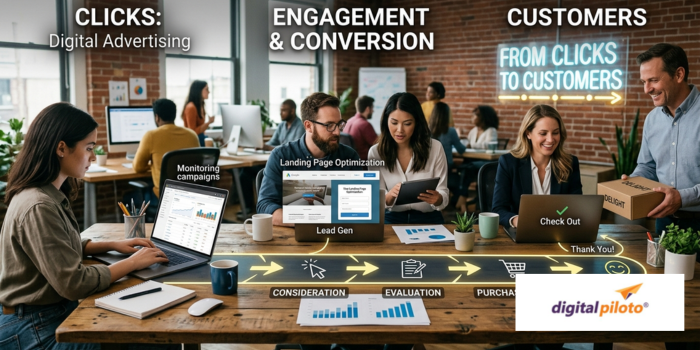
A click is only the beginning. Someone may find an ad, visit a website, read a blog, and disappear without buying anything. So how do successful campaigns close that gap? The answer lies in understanding intent, removing friction, building trust, and guiding prospects through each stage until curiosity becomes a genuine customer relationship.
A Digital Marketing Company in Durgapur does more than generate website traffic. It connects the right audience with the right message, then studies what happens after the click. That second part is where the real marketing work begins.
Why a Click Is Not a Conversion?
It is tempting to celebrate when traffic numbers climb. But 10,000 visitors mean very little if the website cannot persuade even a small portion of them to take the next step.
Modern digital marketing therefore looks at the complete customer journey rather than treating clicks as the finish line. HubSpot's customer journey analytics, for example, can track progression through stages and examine conversion rates and the time between interactions.
Think of it like a physical store. Getting people through the front door matters, but good merchandising, helpful staff, clear pricing, and an easy checkout process determine whether they actually buy.
First, Agencies Identify Real Intent
Not every visitor wants the same thing. Someone searching “what is SEO?” is probably at a different stage from someone searching “SEO agency pricing.” Treating both visitors identically can waste a perfectly good opportunity.
Awareness: The visitor is discovering a problem or possible solution.
Consideration: They are comparing approaches, providers, products, or prices.
Decision: They are looking for evidence that makes taking action feel sensible.
Good campaigns match content and calls-to-action to these different levels of intent instead of pushing every visitor toward an immediate purchase.
Landing Pages Do the Heavy Lifting
Imagine clicking an advertisement promising “faster website performance” and landing on a generic homepage. You now have to hunt for the promised service. That tiny inconvenience can be enough to break the momentum.
Conversion-focused landing pages solve this by continuing the conversation started in the advertisement, search result, or social post. The headline should reinforce the visitor's expectation, while the content answers the obvious questions: What is being offered? Who is it for? Why should I care? What should I do next?
Agencies commonly refine several elements:
Headlines that communicate a specific benefit.
Calls-to-action that clearly explain the next step.
Trust signals such as reviews, case studies, credentials, or client evidence.
Forms that request only information genuinely needed at that stage.
Mobile layouts that keep important information easy to find.
This is also why Best Digital Marketing Company in Durgapur strategies should not stop at ad impressions. The destination experience has to earn the attention the campaign purchased.
Content Keeps Prospects Moving
Some customers buy quickly. Others need three conversations, two comparisons, a case study, and perhaps a weekend to think about it. Digital marketing agencies use content to support those different journeys.
A useful blog can answer an early question. A comparison page can help during research. A case study can reduce uncertainty. An email can bring someone back after they have gone quiet.
HubSpot's 2026 marketing research reports that 33.9% of surveyed marketers identified conversion rates as a key performance indicator, while lead quality was cited by 39.4%. The figures underline a broader shift toward measuring meaningful outcomes rather than celebrating traffic alone.
Data Shows Where the Journey Breaks
Here is where analytics becomes genuinely useful. Suppose 1,000 people visit a landing page, 100 submit a form, but only five become customers. The agency has several questions to investigate. Are the leads poorly qualified? Is the offer unclear? Is sales follow-up slow? Is pricing creating hesitation?
That is why Digital Marketing Agencies In India increasingly need to think beyond channel-level reporting. A campaign may generate inexpensive leads while producing very little revenue.
Useful conversion analysis often focuses on:
Lead quality: Are inquiries coming from the intended audience?
Conversion rate: Which pages, offers, and campaigns produce action?
Customer acquisition cost: How much does it take to acquire an actual customer?
Time to conversion: How long does a prospect typically take to purchase?
HubSpot also recommends examining interactions across the customer journey and using attribution models to understand how different marketing touchpoints contribute to outcomes.
Personalisation Makes the Message Feel Relevant
Good marketing rarely sounds like shouting into a crowded room. It feels more like having the right conversation with the right person.
Agencies can use audience segments, previous interactions, search intent, location, industry, and funnel stage to make messaging more relevant. A returning visitor might see a case study rather than an introductory article. Someone who downloaded a guide might receive a related resource instead of another generic advertisement.
The goal is not to make every interaction clever. Sometimes simple relevance beats flashy personalisation. The prospect should simply feel that the message makes sense for where they are.
FAQ: Turning Clicks Into Customers
1. What is the difference between a click and a conversion?
A click shows that someone interacted with a marketing message. A conversion happens when that visitor completes a desired action, such as submitting an inquiry, booking a consultation, signing up, or making a purchase.
2. How do digital marketing agencies improve conversion rates?
They can improve conversion rates by refining targeting, landing pages, messaging, calls-to-action, content, follow-up processes, and user experience. Testing and analytics help identify which changes actually improve results.
3. Why is lead quality important?
A large number of leads is not automatically valuable. High-quality leads are more closely aligned with the business's target customer and are therefore more likely to progress toward a sale.
4. Which digital marketing metrics should businesses track?
Useful metrics can include conversion rate, qualified leads, customer acquisition cost, revenue attributed to campaigns, and time to customer conversion. The right combination depends on the business model and sales cycle.
Final Thoughts
The best digital marketing does not treat a click as a trophy. It treats it as an invitation to start a conversation. From the first search or advertisement to the final purchase, every interaction should make the next step clearer and easier. When strategy, content, user experience, and measurement work together, clicks have a much better chance of becoming customers.
Blog Development Credits:
This article was ideated by Amlan Maiti, crafted using advanced AI-assisted research tools, and refined with expert SEO strategies by Digital Piloto Private Limited.
Audio - Listen Here


Comments