


How SaaS Companies Can Map Search Intent to Revenue
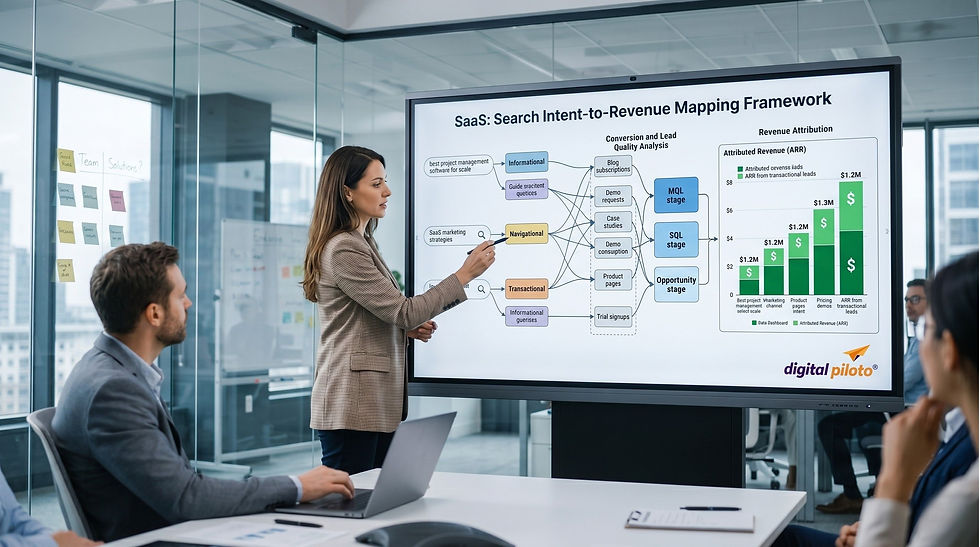
SaaS companies can map search intent to revenue by identifying what potential customers are searching for at each stage of the buying journey and aligning content, product pages, and conversion paths to those specific needs. When done correctly, search intent becomes more than an SEO metric—it becomes a predictable revenue driver that connects organic visibility directly to customer acquisition and business growth.
Many SaaS businesses generate traffic but struggle to convert visitors into paying users. The reason is often simple: they optimize for keywords instead of intent. Companies that understand intent-based marketing consistently outperform competitors because they meet users with the right information at the right moment. This is why even the best digital marketing agency in Kolkata increasingly focuses on intent mapping rather than traffic generation alone.
What Does Mapping Search Intent to Revenue Mean?
Definition
Mapping search intent to revenue is the process of connecting user search behavior with measurable business outcomes such as free trial signups, demo requests, subscriptions, upgrades, and customer retention.
Instead of treating all traffic equally, SaaS companies categorize searches based on where users are in the decision-making process and build experiences that move them closer to a purchase.
The ultimate goal is not higher rankings alone. It is creating a direct relationship between search visibility and revenue generation.
Why Search Intent Matters More Than Search Volume
A common mistake among SaaS marketers is chasing high-volume keywords without considering why users are searching.
For example, a keyword generating 20,000 monthly searches may produce fewer customers than a keyword receiving only 500 searches if the smaller keyword reflects stronger buying intent.
Revenue-focused SaaS brands prioritize intent quality over traffic quantity.
In practical terms, a visitor searching "best CRM software for startups" is often closer to making a decision than someone searching "what is CRM."
The Four Search Intent Categories in SaaS
1. Informational Intent
Users are learning about a problem or concept.
Examples include:
How project management software works
Benefits of customer onboarding tools
What is workflow automation
These searches attract potential future customers and build early-stage awareness.
2. Commercial Investigation Intent
Users are comparing solutions and evaluating options.
Best CRM platforms
Top SaaS analytics tools
Software comparison guides
This stage often presents significant revenue opportunities because users are actively researching solutions.
3. Transactional Intent
Users are ready to take action.
Start free trial
Book software demo
Purchase subscription
These keywords typically produce the highest conversion rates.
4. Navigational Intent
Users are searching for a specific brand, product, or feature.
Strong brand visibility ensures these users easily reach the intended destination.
How SaaS Companies Build an Intent-to-Revenue System
Step-by-Step Format
Identify customer journey stages: Understand how prospects move from awareness to purchase.
Group keywords by intent: Categorize searches into informational, commercial, transactional, and navigational segments.
Create dedicated content assets: Build pages that directly answer user needs.
Match offers to intent: Use guides, demos, trials, and consultations strategically.
Track conversion pathways: Measure how visitors progress through the funnel.
Optimize continuously: Improve pages based on performance and user behavior.
This framework turns search demand into a measurable growth engine rather than a traffic acquisition channel alone.
The Revenue Intent Matrix
One useful way to think about intent mapping is through a Revenue Intent Matrix.
Bullet Explanation Format
Low Intent + High Volume: Awareness content that builds reach.
Medium Intent + Moderate Volume: Comparison content that influences decisions.
High Intent + Lower Volume: Conversion-focused pages that generate revenue.
Brand Intent: Retention and trust-building opportunities.
The most profitable SaaS businesses balance all four categories rather than focusing exclusively on one.
Aligning Content With Revenue Opportunities
Search intent should influence every content decision.
Informational searches require educational resources. Commercial searches require comparisons and case studies. Transactional searches require frictionless conversion experiences.
For example, a SaaS company investing in paid acquisition through a PPC agency Kolkata may discover that high-converting paid keywords can also guide long-term organic content strategies.
This integration between SEO strategy, conversion optimization, and SaaS marketing creates stronger revenue outcomes over time.
Common Mistakes SaaS Companies Make
Targeting keywords based solely on search volume.
Creating generic content that ignores buyer stages.
Failing to connect content with conversion opportunities.
Using identical calls-to-action for all intent levels.
Measuring traffic instead of revenue contribution.
Ignoring post-purchase search behavior.
These mistakes often result in strong traffic metrics but weak business performance.
Why Intent Mapping Is Essential for Modern SaaS Growth
As search engines become increasingly focused on user satisfaction, intent alignment has become more important than keyword matching. AI-powered search systems are also improving their ability to understand context, making intent-driven optimization even more valuable.
Companies working with the best SEO company in Kolkata are increasingly shifting their focus toward intent mapping because it creates a stronger connection between visibility, engagement, and revenue.
The future of SaaS SEO belongs to businesses that understand not just what users search for, but why they search in the first place.
Frequently Asked Questions
1. What is search intent in SaaS marketing?
Search intent refers to the reason behind a user's query, such as learning, comparing solutions, purchasing software, or finding a specific brand.
2. How does search intent impact SaaS revenue?
Intent determines how likely a visitor is to convert. Aligning content with intent improves conversion rates and revenue outcomes.
3. Which search intent generates the most revenue?
Transactional intent usually produces the highest direct revenue because users are ready to take action.
4. Can informational content contribute to revenue?
Yes. Informational content builds awareness, trust, and future demand that often leads to conversions later in the customer journey.
5. How often should SaaS companies review intent mapping?
Intent mapping should be reviewed regularly because customer behavior, market conditions, and search trends evolve continuously.
Conclusion
Mapping search intent to revenue transforms SEO from a traffic-generating activity into a business growth strategy. SaaS companies that understand customer intent at every stage can create more relevant experiences, improve conversions, and build predictable revenue pipelines. In a market where attention is increasingly competitive, intent is often the missing link between visibility and profitability.
Blog Development Credits:
This article was developed from the strategic insights of Amlan Maiti, enriched through advanced AI-assisted research, and finalized with comprehensive SEO enhancements by Digital Piloto Private Limited.


Comments