


Lead Intelligence Framework for SEO, AI Search and Marketing
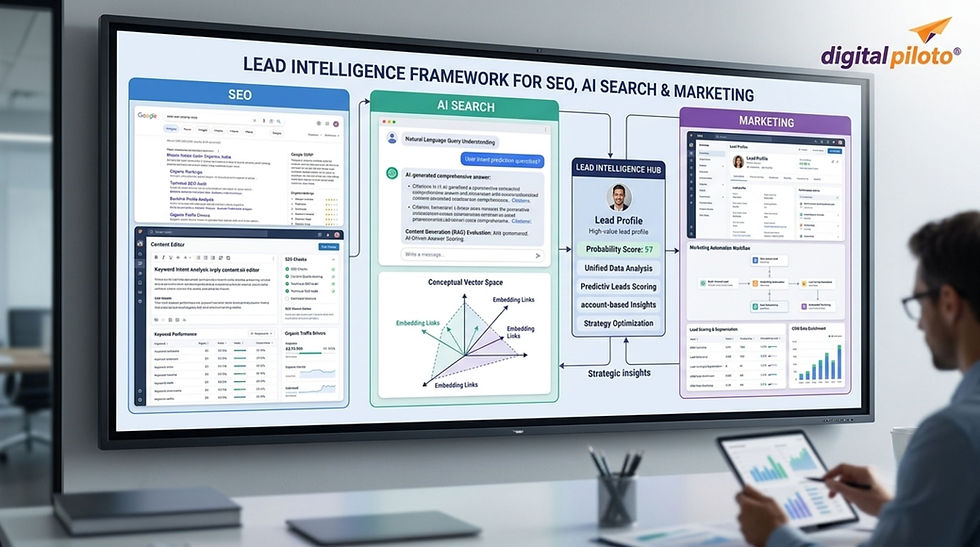
SEO can bring people to a website, but traffic alone does not explain who is ready to buy, who needs more information, or who will disappear after one visit. A modern lead intelligence framework connects search behaviour, AI discovery, marketing signals, and sales data to answer the more useful question: which opportunities deserve attention now?
That shift matters because digital marketing is becoming less linear. A prospect may discover a company through Google, ask an AI assistant for alternatives, read a review, return through a branded search, download a guide, and speak to sales days later. The best digital marketing companies in India are increasingly expected to connect those fragmented signals rather than treat every website visitor as an equal lead.
Lead intelligence is the framework that makes that possible. It combines intent, identity, behaviour, content interaction, search visibility, and business outcomes so marketing teams can spend less time counting activity and more time understanding opportunity.
What Is a Lead Intelligence Framework?
A lead intelligence framework is a structured system for collecting and interpreting the signals that indicate a prospect's interest, intent, fit, and likely next action.
It is broader than lead scoring.
Traditional lead scoring might assign points when someone visits a pricing page, downloads an ebook, or fills out a form. Lead intelligence asks a more nuanced set of questions: What brought this person here? What problem are they researching? How serious does the behaviour appear? Does the account fit the business? Has interest increased or decreased? Which interaction should happen next?
Think of it as moving from a scoreboard to a radar.
A scoreboard tells you what happened. A radar helps you understand what may be approaching.
Why SEO Data Alone Cannot Tell the Whole Story
SEO platforms provide valuable information: impressions, clicks, rankings, queries, landing pages, and conversions. Yet these metrics describe visibility more effectively than intent.
Consider two visitors who both arrive from an organic search.
Visitor A reads a basic educational article for two minutes and leaves. Visitor B searches for pricing, returns to a product page, reads a comparison article, checks an implementation guide, and then visits the contact page.
Both are “organic visitors.” Their commercial value is obviously not identical.
This distinction becomes even more important as AI-powered search changes how people research. Pew Research Center found that in its March 2025 browsing-data study, traditional search-result clicks occurred on 8% of visits when a Google AI summary appeared, compared with 15% when no AI summary appeared. Links inside the AI summaries themselves were clicked in only 1% of visits. Pew Research Center's search behaviour analysis explains the methodology and findings.
The lesson is not that clicks no longer matter. It is that the customer journey increasingly contains meaningful interactions before the click.
The Five Signal Layers of Lead Intelligence
A useful framework can be built around five interconnected signal layers.
1. Discovery signals
These show how someone first encounters a brand. Organic search, paid search, social media, referral traffic, AI-generated recommendations, branded searches, and third-party mentions can all play a role.
The question is simple: Where did the relationship begin?
2. Intent signals
Intent is revealed through behaviour and context. A visitor reading “what is SEO?” is in a different position from someone searching “SEO agency pricing for ecommerce business.”
Useful intent signals include:
Commercial versus informational search queries.
Visits to pricing, service, product, or comparison pages.
Repeated visits within a short period.
Downloads or form interactions.
Questions submitted through chat or conversational interfaces.
Movement from educational content toward transaction-focused pages.
3. Fit signals
Interest does not automatically mean suitability.
A visitor can be highly engaged and still be a poor prospect because of location, company size, budget, industry, service requirements, or buying authority.
Fit signals help answer: Is this the type of customer we actually want?
4. Engagement signals
Engagement becomes more meaningful when viewed as a sequence rather than a collection of isolated events.
Someone who reads six unrelated blog posts may simply be researching. Someone who reads a service guide, case study, pricing explanation, and implementation article may be building a buying case.
5. Outcome signals
This is where marketing intelligence becomes business intelligence.
Leads should eventually be connected to qualified opportunities, sales conversations, revenue, repeat purchases, or other meaningful outcomes. Otherwise, the organisation can become very good at optimising metrics that do not actually pay the bills.
Search Intent Should Become a Lead Signal
One of the biggest opportunities is connecting search intent with lead intelligence.
Most SEO teams already classify queries as informational, navigational, commercial, or transactional. The next step is to connect those categories to actual business outcomes.
Suppose an analytics system shows that visitors who arrive through “how to improve local SEO” rarely become leads, while visitors searching for “local SEO agency for healthcare business” frequently request consultations.
That insight should influence resource allocation.
The goal is not necessarily to stop producing educational content. Educational content can create awareness and trust. But the business should understand its role in the journey instead of assuming that every keyword deserves the same commercial priority.
AI Search Adds a New Intelligence Layer
AI search makes the lead-intelligence conversation even more interesting because discovery can happen without a traditional click.
Customers may ask an AI system to recommend providers, compare products, explain differences, summarise reviews, or identify suitable solutions. In that environment, a brand can influence demand before its analytics platform records a website session.
Pew Research Center reported in June 2026 that 60% of U.S. adults said they had ever read AI summaries at the top of search results. Pew's 2026 research on AI summaries shows how mainstream this behaviour has become.
For marketers, that creates a new question:
What signals indicate that AI-driven discovery is contributing to demand even when the first interaction is not a measurable website click?
That is harder to answer, but it is increasingly important.
Where Generative Search Fits Into Lead Intelligence
AI search visibility should not sit in a separate marketing department, disconnected from lead generation.
A strong generative engine optimization services strategy can help a brand become easier for AI systems to understand and reference, while lead intelligence can reveal what happens after that discovery.
For example, imagine a B2B software company starts appearing more frequently in AI-generated comparisons. Website traffic increases modestly, but branded searches, direct visits, demo requests, and sales conversations increase significantly.
A conventional SEO dashboard might underestimate the change.
A broader intelligence framework can connect the dots.
This is particularly important because AI search is often part of a multi-step journey rather than the entire journey. A prospect may receive a recommendation from an AI system, independently verify the brand, visit its website later, and convert through a direct channel.
Build a Lead Intelligence Scoring Model
A practical scoring system does not need to be ridiculously complicated. In fact, complexity can make it harder for sales and marketing teams to trust the model.
A useful framework might score four dimensions:
Intent: How strongly does the person's behaviour suggest an active problem or buying need?
Fit: How closely does the prospect match the ideal customer profile?
Engagement: How consistently are they interacting with meaningful content or commercial assets?
Recency: How recently did high-intent activity occur?
Imagine a lead has strong company fit, has visited pricing twice, read a case study, and requested a consultation within 48 hours. That prospect should obviously receive different treatment from someone who downloaded a general industry report six months ago.
The score should reflect that difference.
From Lead Scoring to Next-Best Action
Scoring tells you who may matter. Intelligence should also help determine what to do next.
A high-intent lead might need a sales conversation. A moderately engaged prospect might need a comparison guide. Someone who repeatedly visits implementation content may respond better to a technical consultation than another promotional email.
This is where AI can move marketing beyond static segmentation.
Salesforce's 2026 India marketing research found that 81% of marketers in India had adopted AI, while 92% said customers increasingly expect brands to support two-way conversations. The same research found that fragmented or irrelevant data remains a major obstacle to personalised engagement. Salesforce's India State of Marketing findings provide the underlying methodology and results.
The implication is important: AI can recommend next actions, but the quality of those recommendations depends heavily on the quality and connectedness of customer data.
Content Should Be Connected to Commercial Intent
Content marketing often becomes a publishing exercise. More articles, more keywords, more impressions.
Lead intelligence changes the question.
Which content actually helps customers progress?
A company might discover that a detailed implementation guide produces fewer visitors than a generic “ultimate guide,” yet generates significantly more qualified enquiries. That guide deserves attention even if its traffic numbers look modest.
This is why a best SEO services India strategy should connect keyword research with lead quality, sales feedback, conversion paths, and customer intent rather than treating rankings as the final objective.
Use Lead Intelligence Across the Funnel
A mature framework should not be restricted to the moment when someone fills out a form.
It should support the entire journey:
Awareness: Identify which topics, queries, and channels introduce new prospects.
Consideration: Detect research patterns, comparison behaviour, and recurring objections.
Evaluation: Identify pricing, service, product, and proof-related interactions.
Conversion: Prioritise high-intent prospects and remove unnecessary friction.
Retention: Feed customer behaviour back into future acquisition and personalisation.
This creates a feedback loop. Marketing learns from sales. SEO learns from conversions. Content learns from customer questions. AI search strategy learns from discovery patterns.
Suddenly, these are no longer separate activities.
The Data Problem Nobody Should Ignore
Lead intelligence sounds impressive until a business tries to connect its systems.
CRM data may use one customer identifier. Analytics may use another. Advertising platforms have their own attribution models. Search data describes queries rather than people. Sales teams may store useful context in notes that never reaches the marketing platform.
The result is a fragmented picture.
Salesforce found that marketers with satisfactorily unified customer data were 1.6 times more likely to use AI agents to scale marketing efforts in its India research. The full Salesforce report also highlights the lack of connected customer information as a significant barrier to personalisation.
So before buying another AI platform, businesses should ask a less glamorous question: Can our existing systems actually agree on what happened?
That question saves money.
What the Future Looks Like
The next stage of lead intelligence will likely be more continuous and less campaign-centric.
McKinsey reported in 2026 that 90% of surveyed CMOs were experimenting with AI use cases, yet fewer than 10% had scaled AI or captured value across marketing workflows. The firm argues that businesses need to redesign marketing around continuous insights, personalisation, experimentation, orchestration, and AI-enabled decision-making rather than simply adding isolated AI tools. McKinsey's 2026 analysis of AI and marketing explores that transition.
For lead generation, that could mean systems that continuously watch for changes in intent, identify emerging account interest, detect content gaps, recommend next-best actions, and send meaningful signals to sales.
Human judgement still matters. Probably more than ever.
AI can identify patterns across thousands of interactions, but experienced marketers understand nuance: seasonality, cultural context, customer anxiety, brand positioning, and the difference between curiosity and genuine buying intent.
The winning model is not human versus AI. It is human judgement with much better intelligence.
A Practical Lead Intelligence Checklist
Businesses beginning this journey can start with a relatively straightforward audit:
Identify the highest-value customer segments.
Map their important search and discovery questions.
Connect search behaviour with website engagement.
Define meaningful intent and fit signals.
Connect marketing leads with CRM and sales outcomes.
Measure content by qualified opportunities, not traffic alone.
Monitor AI-search visibility alongside traditional organic performance.
Create clear next-best-action rules for different lead stages.
Review data quality and identity resolution regularly.
Use actual sales outcomes to improve scoring models.
The framework does not need to be perfect on day one. It needs to become progressively more useful.
Frequently Asked Questions
What is lead intelligence in digital marketing?
Lead intelligence is the process of combining customer, search, engagement, intent, fit, and sales signals to understand which prospects are most valuable and what action should happen next.
How is lead intelligence different from lead scoring?
Lead scoring usually assigns points to selected behaviours or characteristics. Lead intelligence goes further by combining multiple signals, understanding context, connecting marketing with sales outcomes, and helping determine the next best action.
Can AI search data be used for lead intelligence?
Yes. AI-driven discovery can provide useful strategic signals around customer questions, brand visibility, recommendation behaviour, and changing search journeys. These signals should be combined with measurable website, CRM, and sales data rather than treated as standalone proof.
Why is unified data important for AI-powered lead generation?
AI systems depend on reliable context. When customer, marketing, sales, and service information is fragmented, models may produce incomplete or misleading recommendations. Better-connected data generally creates a stronger foundation for intelligent personalisation and lead prioritisation.
Final Thoughts
Lead generation is entering a more intelligent phase. The goal is no longer to collect the largest possible number of contacts and hope the sales team can sort them out.
The smarter approach is to understand the signals behind demand.
SEO tells you what people search for. AI search reveals new paths through which people discover answers. Marketing analytics shows what they do. CRM data shows what becomes commercially meaningful. Lead intelligence brings those pieces together.
When those systems begin speaking the same language, marketing becomes less about chasing activity and more about recognising opportunity. And that, ultimately, is what makes SEO, AI search, and marketing work better together.
Blog Development Credits
Conceptualised by Amlan Maiti, this article was AI-assisted in research and drafting, then refined with final SEO enhancements by Digital Piloto Private Limited.


Comments