


The Rise of Agentic SEO: Can Autonomous AI Agents Run SEO Workflows?
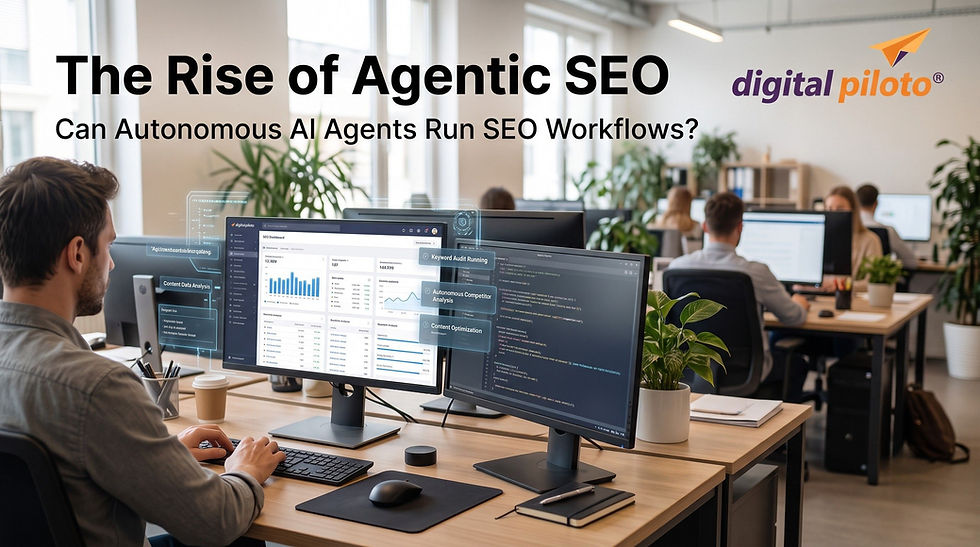
SEO has always involved a curious mix of routine and uncertainty. Audits need repeating, content needs updating, and search behavior keeps changing just when a strategy seems settled. Now, autonomous AI agents are beginning to change how these tasks are managed. Could they run entire SEO workflows independently, or will human expertise remain essential? The reality sits somewhere between those two possibilities.
For businesses investing in digital marketing services in India, agentic SEO presents an opportunity to move beyond isolated automation. Instead of using separate tools for keyword research, technical audits, and reporting, companies can build connected workflows that identify problems, recommend actions, and monitor outcomes. The important question is not whether AI can do SEO tasks, but how much responsibility it should have.
What Is Agentic SEO?
Agentic SEO uses AI agents to pursue defined search optimization goals through a sequence of connected actions. Depending on their capabilities and permissions, these agents can collect information, interpret findings, select a next step, use external tools, and evaluate the result.
That is different from ordinary automation. A scheduled script might send an email when a page returns an error. An AI agent could investigate the affected URL, examine related pages, assess the likely impact, and prepare a recommended fix. If the task falls within an approved set of low-risk actions, it might even resolve the problem automatically.
Think of it as the difference between a smoke detector and a building manager. One alerts you to a possible problem; the other investigates what is happening and coordinates an appropriate response. An AI agent is not a perfect building manager, of course, but the analogy explains why this technology is attracting attention.
Agentic SEO does not mean handing an entire website to an uncontrolled algorithm. It means designing a system that can handle defined responsibilities while respecting clear limits.
Why SEO Workflows Are Moving Beyond Basic Automation
Traditional SEO workflows often depend on people moving information between tools. A specialist runs an audit, exports a report, checks analytics, compares competitor pages, and turns the findings into a list of recommendations. Someone else may then implement the changes and review performance later.
Each step has value, but the handoffs consume time. They also create opportunities for important details to be missed.
AI agents can connect parts of this process. For example, an ecommerce website might experience a decline in organic clicks across a group of product pages. An agent could examine available search-performance data, review recent website changes, identify shared technical issues, and prepare a prioritized investigation for the SEO team.
Rather than starting from scratch each time, the team receives a more organized picture of the problem. With carefully configured integrations, selected actions can then move through approval and implementation without repeated manual coordination.
The potential advantage is not simply speed. It is continuity: the ability to notice a change, investigate it, and carry the work forward while the evidence is still relevant.
Five SEO Workflows Autonomous AI Agents Can Manage
1. Technical SEO Monitoring and Issue Detection
Technical problems rarely arrive at convenient times. A website migration, plugin update, or template change can introduce broken links, missing metadata, redirect errors, or indexing issues.
An AI agent connected to approved crawling and monitoring tools can detect unusual changes, group related errors, and rank them by potential importance. It might flag a problem affecting an entire service-page template as more urgent than a minor issue on a low-value archive page.
Some fixes can be automated safely, particularly when the rule is clear and the change is reversible. More consequential changes, such as modifying canonical tags across thousands of URLs, should trigger human review.
The practical benefit is a more responsive technical SEO workflow, not a promise that every issue will be discovered or fixed correctly.
2. Keyword Research and Search Intent Analysis
Keyword research becomes more useful when it reveals what potential customers are trying to accomplish. Search phrases may indicate early research, product comparisons, implementation questions, or an immediate intention to buy.
An agent can analyze approved keyword datasets, search queries, existing pages, and competitor content to uncover patterns. It may identify a cluster of questions that the website answers poorly or find that two articles compete for similar search intent.
Imagine a business selling accounting software. An agent could distinguish searches about bookkeeping basics from searches comparing accounting platforms. Instead of recommending a generic article for every phrase, it could suggest a beginner's guide for one group and a detailed product comparison for the other.
This supports smarter keyword clustering and content planning. Human review remains necessary to confirm that the proposed topics match the business, its audience, and its actual expertise.
3. Content Optimization and Maintenance
Publishing content is only half the job. Articles become outdated, products change, links break, and customer questions evolve. On a large website, reviewing every page manually can be a slow and inconsistent process.
An agent can monitor content inventories and performance signals to flag pages that may need attention. It might recommend clarifying an explanation, adding a relevant internal link, updating a verified product detail, or consolidating overlapping content.
It can also draft suggested improvements for an editor to review. If the system has permission to publish certain changes, the workflow should still include factual checks, version history, and a way to reverse mistakes.
One principle deserves particular attention: more content is not automatically better SEO. An agent that recommends publishing new pages for every minor keyword variation may create duplication rather than value. Sometimes the best recommendation is to improve one useful page and leave the rest alone.
4. Internal Linking and Content Relationships
Internal links help visitors discover relevant information and help search engines understand how pages relate to one another. Yet linking decisions become complicated as a website grows.
An AI agent can review a site's page inventory, identify relevant relationships, and suggest links between supporting articles and important service pages. For example, a guide about local search could link naturally to a detailed resource about local SEO services if that destination genuinely helps the reader.
The agent should evaluate relevance rather than inserting exact-match keywords everywhere. Repeated, awkward anchor text can damage the reading experience, and a technically valid link is not necessarily a useful one.
Human approval is especially valuable for links involving commercial claims, sensitive topics, or pages whose relationship is not immediately obvious.
5. SEO Reporting and Performance Feedback
SEO reporting often tells teams what changed without explaining what deserves attention next. An agent can help connect the two by identifying unusual performance movements, comparing relevant periods, and preparing questions for further investigation.
Suppose a service page receives more impressions but fewer clicks. The agent might recommend reviewing search-result presentation, query relevance, and competing results before suggesting a title change. It should also distinguish a plausible explanation from a confirmed cause.
After an approved change, the system can monitor subsequent performance and record the outcome. This creates a feedback loop that helps teams learn from previous decisions instead of repeatedly performing the same analysis.
How to Build a Connected Agentic SEO Workflow
Running individual AI experiments is relatively easy. Building a dependable workflow is harder because the system needs reliable data, appropriate access, clear responsibilities, and measurable goals.
A digital innovation company in India can help businesses assess the technical integrations and operating processes required to connect SEO tools with AI-driven workflows. The aim should be to solve a specific business problem, not to introduce complexity for its own sake.
A practical workflow can follow these steps:
Define the objective: Choose a measurable goal, such as reducing technical issue resolution time or improving the relevance of internal links.
Connect the right data: Provide access only to the approved analytics, crawl reports, content records, and website systems the agent needs.
Start with recommendations: Allow the agent to analyze information and propose actions without changing live pages.
Test its decisions: Compare the agent's findings with expert reviews, noting false alarms, missed issues, and incorrect recommendations.
Introduce controlled execution: Permit clearly defined, low-risk actions once the workflow demonstrates acceptable reliability.
Review outcomes: Measure business impact, errors, implementation quality, and the time saved by the process.
This staged approach makes it easier to expand automation responsibly. It also gives the business a chance to discover where human intervention continues to add the most value.
Can Agentic SEO Improve Business Results?
It can contribute, but the outcome depends on the quality of the strategy and implementation. Faster reporting is useful, yet it is not the same as better organic visibility or more qualified leads.
Businesses should connect SEO activity to meaningful measures, including relevant organic clicks, qualified enquiries, conversion rates, important technical errors, and the time needed to resolve problems. Rankings can provide context, but they should not be the only measure of success.
When evaluating an India SEO company, ask how it validates agent recommendations, protects website quality, and reports measurable results. A credible approach should explain what is automated, what requires approval, and how mistakes are detected and corrected.
Google's guidance on helpful, reliable, people-first content is a useful reference for AI-assisted SEO. Content should serve a genuine audience, answer relevant questions, and provide value beyond its ability to target a search phrase. Automation does not remove that responsibility.
The Risks of Giving AI Too Much Control
An autonomous system can scale good decisions, but it can scale bad ones just as quickly. If an agent misunderstands a traffic decline, it might recommend unnecessary rewrites across many pages. If it has excessive publishing permissions, one faulty instruction could affect an entire website section.
Businesses should establish safeguards before increasing autonomy:
Use permission limits: Keep major redirects, mass content changes, and important indexing directives behind human approval.
Maintain change records: Log each action, its reason, and the outcome, with reliable rollback options.
Validate important facts: Check claims, product information, and commercial details against trustworthy sources.
Escalate uncertainty: Require review when evidence is incomplete or a recommendation could cause significant harm.
Protect data: Apply appropriate access controls and privacy practices to connected systems.
These safeguards are not signs that agentic SEO has failed. They are part of designing a system that can be trusted with increasingly important work.
Frequently Asked Questions
1. What is agentic SEO?
Agentic SEO uses AI agents to pursue defined optimization goals by gathering information, analyzing problems, selecting next steps, and monitoring outcomes. Depending on their permissions, agents can recommend changes or execute selected tasks under controlled conditions.
2. Can autonomous AI agents run an entire SEO workflow?
Agents can coordinate many activities, including technical monitoring, keyword analysis, content reviews, and reporting. However, fully independent management is risky because strategy, brand context, factual accuracy, and high-impact decisions still require appropriate human oversight.
3. Is agentic SEO suitable for small businesses?
Yes. Small businesses can start with focused workflows such as broken-link monitoring, content maintenance, or search-performance summaries. A narrow, measurable use case is generally more practical than investing in a complex system before its value is clear.
4. Will agentic SEO guarantee higher Google rankings?
No. AI agents can help identify opportunities and implement useful improvements, but rankings depend on many factors, including relevance, competition, website quality, and search intent. Businesses should measure long-term performance and commercial outcomes rather than expect guaranteed results.
Final Thoughts
Agentic SEO is a meaningful step beyond routine automation. It offers a way to connect monitoring, analysis, implementation, and learning into workflows that respond to changing search conditions. Still, the goal should not be to remove people from SEO. It should be to reduce repetitive work, improve the quality of decisions, and give experienced teams more time to focus on strategy, customers, and sustainable organic growth.
Blog Development Credits
The topic was conceptualized by Amlan Maiti, with research and drafting assistance from AI tools where applicable. Final editorial refinement and SEO enhancements were provided by Digital Piloto Private Limited.


Comments