How Generative Search Is Redefining Brand Authority

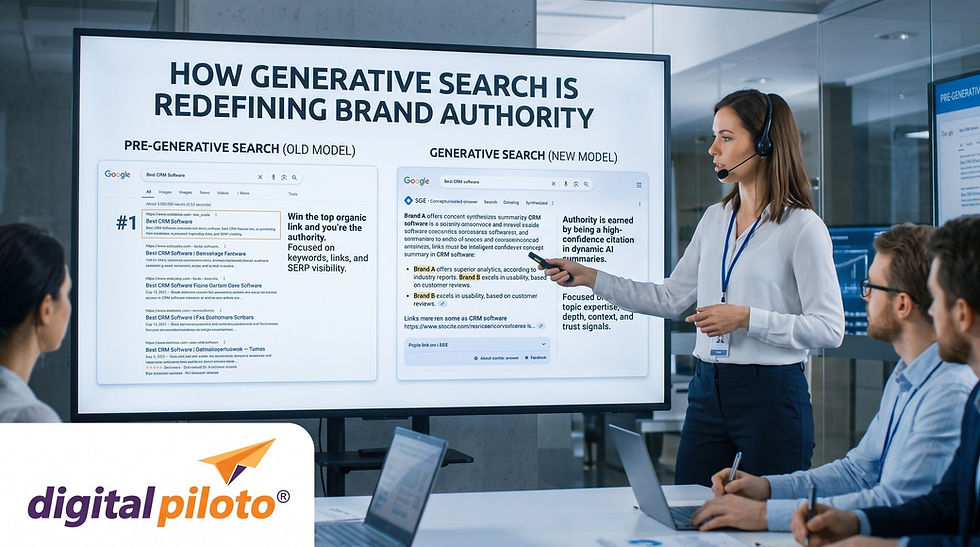
Search once rewarded brands for winning a position. Generative search is beginning to reward something broader: being trusted enough to become part of the answer. As AI systems summarize, compare, cite, and recommend information, brand authority is no longer built only through rankings. It is built through expertise, consistency, evidence, and meaningful digital presence.
For modern SEO companies in India, this represents a major change in strategy. A page can rank well and still have limited influence if AI systems cannot confidently understand what the brand does, why it matters, or whether its claims are supported elsewhere.
Brand Authority Used to Start With Rankings
For years, the basic SEO ambition was wonderfully straightforward: get onto page one, preferably near the top.
That made sense. If a customer searched for a service and saw your company in the first few results, you had earned an important moment of attention.
But search behavior is becoming more conversational.
A potential customer might now ask an AI-powered search engine, “Which Indian digital marketing agencies are strongest for a company that wants SEO, AI search visibility, and performance marketing?”
That is not simply a request for links. It is a request for judgment.
The system has to interpret the category, understand the customer's needs, compare possible businesses, and construct a useful response. Suddenly, authority is less about occupying one position and more about having enough credible signals to be included in the recommendation.
That is a fundamental change.
Generative Search Is Becoming a Major Discovery Layer
Generative search is no longer an experimental side feature that marketers can casually ignore.
In 2026, Google reported that AI Overviews had more than 2.5 billion monthly active users, while AI Mode had passed 1 billion monthly users. Google also said AI-powered search experiences were contributing to record levels of Search usage. Google's 2026 investor presentation provides the reported figures.
The scale is difficult to dismiss.
More importantly, the behavior is changing. Search is becoming less like a collection of isolated queries and more like an ongoing conversation. A person can ask one question, request clarification, challenge the answer, compare alternatives, and narrow the decision without repeatedly starting from scratch.
That creates a new environment for brands.
The customer may encounter your company while asking about a problem, not while searching for your company by name.
Authority Is Becoming a Multi-Signal Concept
Traditional SEO often gives marketers a convenient set of signals to monitor: rankings, backlinks, organic traffic, impressions, and clicks.
Generative search introduces a more complicated question: Does the wider web provide enough evidence for an AI system to understand and trust this brand?
Consider a fictional cybersecurity company called SecureNorth.
Its website says it specializes in enterprise cybersecurity. Fine.
But imagine that industry publications also discuss its research, customers publish reviews, experts associated with the company contribute to security discussions, its executives have credible professional profiles, and its website contains detailed technical resources.
Those independent signals reinforce the company's own claims.
Now compare that with a business that repeatedly describes itself as an “industry-leading cybersecurity company” but has little supporting evidence outside its own website.
Both brands can write excellent title tags.
Only one has built a convincing authority ecosystem.
The Web Around Your Website Matters More
This is one of the most important ideas in generative search.
Your website is not the entire story.
AI systems can encounter information about your brand across many places: news articles, professional networks, reviews, directories, forums, videos, industry publications, partner websites, research papers, interviews, social profiles, and other authoritative sources.
These sources can collectively help establish what a brand is known for.
That does not mean businesses should start chasing random mentions everywhere. In fact, that can create noise rather than authority.
The better objective is relevant corroboration.
If a company genuinely specializes in ecommerce SEO, for example, its expertise should ideally be visible through multiple credible signals related to ecommerce, search, analytics, technology, and customer outcomes.
Authority becomes stronger when the story is consistent.
Why Consistency Matters to Generative Systems
Imagine meeting someone who introduces themselves as a software developer.
Later, their professional profile says they are a financial consultant. Their company website calls them a graphic designer. A conference biography describes them as a cybersecurity researcher.
You would probably hesitate before deciding what they actually do.
AI systems face a similar problem when brand information is inconsistent across the web.
That is why entity clarity matters.
A business should make it easy to determine:
What the company is.
Which products or services it provides.
Which industries or audiences it serves.
Where it operates.
What expertise it genuinely possesses.
How it differs from comparable businesses.
Which people are associated with its expertise.
The clearer the entity, the easier it becomes for search systems—and humans—to understand what the brand should be associated with.
Generative Search Changes What “Good Content” Means
There was a period when content marketing became obsessed with producing more.
More blog posts. More keyword variations. More landing pages. More “ultimate guides.”
Generative search makes that strategy look increasingly fragile.
AI systems can summarize generic information very efficiently. If your article simply repeats what hundreds of other pages already say, there may be little reason for it to become a distinctive source of authority.
The stronger opportunity lies in creating content that contributes something difficult to synthesize from generic material.
What creates stronger authority?
Original research: Data, surveys, experiments, observations, and industry findings.
First-hand experience: Case studies, implementation lessons, failures, results, and practical examples.
Expert interpretation: Opinions supported by evidence rather than generic commentary.
Specific frameworks: Clear processes that help readers solve complicated problems.
Useful comparisons: Honest explanations of when different approaches make sense.
In short, the question is no longer “How much content can we publish?”
It is “What information can we publish that makes our expertise genuinely useful?”
AI Citations Are Changing the Visibility Equation
Generative search often produces answers that reference multiple sources. That creates a new form of visibility: citation visibility.
A brand may not receive the first traditional ranking position, yet its research or explanation could become a source that an AI-generated answer references.
This matters because citation can function as a credibility signal in the user's mind.
A 2025 Pew Research Center analysis of nearly 69,000 Google searches found that 88% of AI summaries in its dataset cited at least three sources. The same research found that users were less likely to click traditional results when an AI summary appeared: 8% of visits with an AI summary led to a traditional result click, compared with 15% when no AI summary appeared. Pew Research Center's analysis explains the findings and methodology.
The implication is not that clicks no longer matter.
It is that the moment of influence can happen before the click.
If your brand is cited, described accurately, or used as supporting evidence, it has already participated in the customer's research process.
Brand Authority Is Becoming More Topical
Another shift is happening beneath the surface: authority is becoming more closely connected to topics and contexts.
A company does not need to be “authoritative about everything.” In fact, trying to appear knowledgeable about everything can weaken positioning.
Imagine a company known for technical SEO for large ecommerce stores.
Its authority becomes clearer when its content consistently demonstrates expertise in:
Technical ecommerce architecture.
JavaScript and crawlability.
Product-page optimization.
Faceted navigation.
Structured data.
International ecommerce SEO.
Search performance measurement.
Over time, this creates a recognizable knowledge territory.
That is much more powerful than publishing one article about SEO, another about social media, another about cryptocurrency, and another about office productivity simply because those keywords have search volume.
Authority needs a center of gravity.
Generative Search Rewards Depth Over Keyword Repetition
Keyword relevance still matters, of course. Search systems need language to understand what a page is about.
But generative search makes semantic depth more valuable.
Suppose someone searches for “best CRM for a growing B2B company.”
A shallow article may list ten CRM platforms and repeat the phrase “best CRM” twenty times.
A genuinely useful resource might explain how CRM choices differ according to sales-team size, implementation complexity, integrations, reporting requirements, automation needs, pricing models, and customer-support expectations.
The second resource gives an intelligent system much more context to work with.
It also gives a human reader more reason to trust the publisher.
That overlap is important. The best generative-search strategy is rarely about writing for machines instead of people. It is about making information so clear, useful, specific, and well-supported that both can understand its value.
GEO Becomes Part of the Authority Strategy
This is where a generative AI SEO agency can bring a broader perspective to search strategy.
Generative Engine Optimization, or GEO, focuses on improving brand visibility within AI-generated answers and generative discovery environments.
But good GEO should not be reduced to trying to “get mentioned by AI.” That is too narrow.
The stronger objective is to build the conditions that make accurate, useful brand representation more likely.
That can involve improving entity clarity, strengthening authoritative content, building credible external references, demonstrating expertise, creating original information, and making important facts easy to discover and interpret.
In that sense, GEO is closely connected to reputation.
The brand is effectively building a body of evidence that intelligent systems can draw upon.
Reviews and Real-World Experience Matter
Authority cannot live entirely inside polished corporate content.
Customers create signals too.
Reviews, testimonials, independent discussions, case studies, product feedback, and community conversations can reveal whether a company's marketing claims match reality.
That is especially important for businesses where trust strongly influences purchasing decisions.
A healthcare provider, financial company, educational institution, software vendor, or professional service business cannot build durable authority through promotional copy alone.
Real-world experience matters.
This creates an interesting feedback loop: a better customer experience can generate stronger reviews and word-of-mouth, which can strengthen the brand's broader digital footprint, which can then contribute to future discovery.
In other words, SEO and customer experience are becoming harder to separate.
The Brand Becomes the Content Ecosystem
One of the most useful ways to think about generative search is to stop treating individual pages as isolated assets.
Your brand is an ecosystem.
The homepage explains the business. Service pages explain what it does. Case studies demonstrate results. Author profiles establish expertise. Reviews provide customer evidence. External publications provide independent validation. Social profiles add context. Research and original insights demonstrate knowledge.
Each piece contributes something different.
Together, they create a more complete identity.
That is increasingly important because generative systems are not simply matching one query to one webpage. They can synthesize information from multiple sources to construct an answer.
If your digital footprint provides useful pieces of that answer, the brand has a better chance of becoming part of the conversation.
How Businesses Can Build Generative-Search Authority
There is no magic “AI authority” button. The fundamentals are surprisingly practical.
Define your expertise: Identify the subjects your brand can credibly own rather than trying to cover everything.
Create original information: Publish research, proprietary insights, case studies, examples, and practical frameworks.
Strengthen expert identity: Make authors, specialists, founders, and contributors clearly connected to their areas of expertise.
Improve entity consistency: Keep company descriptions, services, locations, leadership information, and brand details accurate across important platforms.
Earn relevant external recognition: Pursue meaningful industry mentions instead of collecting low-value links or directory listings.
Monitor AI representation: Test important category questions and examine how AI systems describe, compare, or cite your brand.
None of these steps is particularly glamorous.
That is probably a good thing.
Long-term authority is usually built through dozens of sensible actions rather than one clever trick.
What This Means for Marketing Teams
Generative search is also changing the relationship between SEO and the rest of marketing.
Content teams need to understand customer questions. PR teams need to think about credible mentions. Social teams contribute to brand context. Customer-service teams influence reviews and reputation. Product teams create the experiences that customers eventually talk about.
SEO increasingly sits in the middle of all these activities.
That is why businesses looking for a digital marketing service provider in India should evaluate more than technical SEO capabilities. The stronger partner is one that understands how content, brand reputation, search behavior, customer experience, and AI discovery interact.
Generative search is not creating an entirely new marketing universe. It is connecting parts of the existing one more tightly.
The New Definition of Brand Authority
So, what does brand authority actually mean in a generative-search environment?
It means that when an intelligent system encounters a question related to your category, your brand has a clear and credible place in the surrounding knowledge landscape.
It means the company is not known only because its own website says it is good.
It is supported by evidence.
It is associated with a recognizable area of expertise.
Its information is consistent.
Its customers provide real-world validation.
Its experts contribute meaningful ideas.
Its content answers questions better than generic alternatives.
And importantly, the brand can be understood without a human having to piece together contradictory information from ten different places.
Frequently Asked Questions
1. What is generative search?
Generative search uses AI to interpret a user's query and create a synthesized response, often combining information from multiple sources instead of simply presenting a traditional list of links.
2. How does generative search affect brand authority?
It shifts authority from being primarily associated with rankings toward a broader combination of expertise, credible citations, entity clarity, original content, external recognition, and consistent information across the web.
3. What is GEO in relation to brand authority?
GEO, or Generative Engine Optimization, focuses on improving how brands are represented within AI-generated answers. It supports authority by strengthening the information, evidence, and contextual signals that help AI systems understand a brand.
4. Does traditional SEO still matter for generative search?
Yes. Technical accessibility, relevant content, strong information architecture, authority, and other SEO fundamentals remain important. Generative search expands the visibility equation rather than making traditional SEO irrelevant.
Final Thoughts
Generative search is changing the question brands need to answer.
It is no longer enough to ask, “How can we rank higher?”
A better question is: “Why should an intelligent system trust us enough to include us in the answer?”
The answer will rarely be one optimized page. It will be the accumulated weight of expertise, evidence, customer experience, useful content, credible mentions, and a consistent digital identity.
That is what makes this shift so interesting. Generative search may ultimately push SEO closer to what it was always supposed to be: not a contest for visibility alone, but a disciplined effort to become genuinely useful and trustworthy in the places where people make decisions.
Blog Development Credits
Conceptualized by Amlan Maiti, researched through AI-assisted tools, and polished with strategic SEO improvements by Digital Piloto Private Limited.



Comments