Location Entity SEO Framework

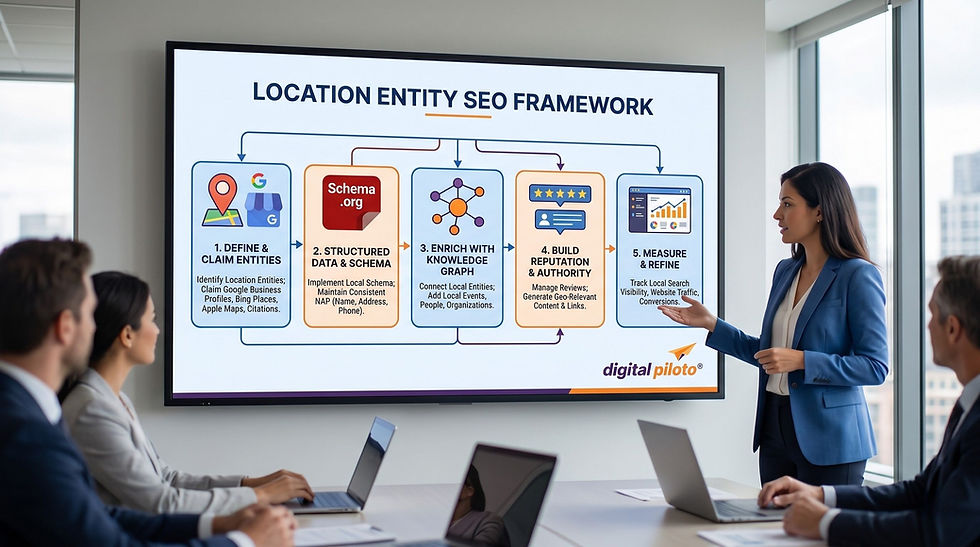
A Location Entity SEO Framework is a structured approach to helping search engines and AI systems understand the geographic relevance of a business, service, or brand. Instead of simply targeting location-based keywords, this framework builds strong relationships between businesses, places, services, and local intent signals, making content more discoverable in both traditional and AI-powered search environments.
Today, local visibility depends on more than ranking for city names. Search engines increasingly evaluate location entities, business relationships, user intent, and contextual relevance. Whether you're a local retailer, service provider, or the best digital marketing agency in Kolkata, understanding location entity optimization can significantly improve your search performance.
What Is a Location Entity SEO Framework?
Definition
A Location Entity SEO Framework is a methodology that strengthens the connection between a business and its relevant geographic entities to improve discoverability in local and AI-driven search results.
Location entities include:
Cities
Neighborhoods
Districts
Service areas
Landmarks
Regional business ecosystems
The framework helps search engines confidently associate your business with specific locations and user search intent.
Why Location Entities Matter More Than Keywords
Many businesses still focus exclusively on inserting city names into content. While location keywords remain useful, modern search algorithms rely heavily on entity relationships.
For example, if a business consistently appears alongside references to local landmarks, industry associations, customer reviews, and geographic signals, search engines gain stronger confidence about its location relevance.
This shift is especially important as AI-powered search engines increasingly prioritize context over keyword frequency.
The Core Components of a Location Entity SEO Framework
1. Geographic Entity Mapping
Identify every location entity connected to your business.
Primary city
Surrounding service areas
Local landmarks
Business districts
Regional markets
This creates a complete geographic relevance network.
2. Business Entity Alignment
Ensure your business information remains consistent across all platforms.
Business name
Address
Phone number
Operating hours
Service descriptions
Consistency strengthens trust signals and entity recognition.
3. Content-Based Location Reinforcement
Create content that naturally demonstrates local expertise.
Instead of repeating city names, discuss local challenges, market conditions, customer needs, and regional opportunities.
How to Build a Location Entity SEO Framework
Step 1: Identify Primary Location Entities
List all geographic areas that directly influence your business visibility.
Focus on locations where customers actually search for your services.
Step 2: Create Entity-Focused Content Clusters
Develop content around location-specific topics.
Local service pages
Area guides
Industry insights
Community-focused resources
This helps search engines understand the depth of your local relevance.
Step 3: Strengthen Internal Linking
Connect location-related content strategically.
For businesses offering SEO service Kolkata, location-specific pages should link naturally to relevant service resources and supporting content.
Step 4: Implement Structured Data
Schema markup helps search engines interpret location entities accurately.
Local Business Schema, Organization Schema, and Service Schema provide valuable contextual information.
Step 5: Monitor Entity Signals
Track mentions, citations, reviews, and local engagement indicators.
The stronger the entity network becomes, the more authoritative your location presence appears.
Common Mistakes That Reduce Location Authority
Overusing Location Keywords
Keyword stuffing city names often creates unnatural content and weakens credibility.
Ignoring Entity Relationships
Businesses frequently overlook nearby locations, landmarks, and related entities that strengthen geographic context.
Inconsistent Business Information
Differences in business details across directories can confuse search engines and reduce trust.
Thin Local Landing Pages
Many local pages contain little more than a location name and generic service description.
Modern search systems reward meaningful local information instead.
The Role of Paid Search in Location Validation
Paid search campaigns can reveal valuable geographic insights.
A PPC company in Kolkata often gathers location-specific performance data that helps identify high-converting regions, user behaviors, and emerging opportunities.
These findings can improve organic location strategies and strengthen entity associations over time.
Benefits of a Strong Location Entity SEO Framework
Search Visibility Benefits
Improved local rankings
Enhanced AI search inclusion
Better entity recognition
Higher geographic relevance
Business Benefits
More qualified local traffic
Increased trust and credibility
Higher conversion rates
Stronger competitive advantage
Most importantly, businesses become easier to understand, recommend, and retrieve across modern search ecosystems.
Frequently Asked Questions
What is a location entity in SEO?
A location entity is a recognized geographic place, such as a city, neighborhood, district, or landmark that search engines use to understand local relevance.
How is entity SEO different from local keyword optimization?
Entity SEO focuses on relationships and contextual understanding, while keyword optimization focuses primarily on matching search terms.
Why are location entities important for AI search?
AI search systems rely heavily on entity relationships to determine relevance, authority, and geographic accuracy.
Can small businesses benefit from location entity optimization?
Yes. Small businesses often gain significant local visibility improvements by strengthening geographic relevance and entity associations.
What schema markup supports location entity SEO?
Local Business Schema, Organization Schema, Place Schema, and Service Schema are commonly used to strengthen location understanding.
Conclusion
The future of local SEO is increasingly entity-driven. Businesses that build strong relationships between their brand, services, and geographic locations create a foundation that search engines and AI systems can trust. A well-executed Location Entity SEO Framework doesn't just improve rankings—it improves discoverability, credibility, and long-term local authority.
Blog Development Credits:
This article originated from strategic concepts developed by Amlan Maiti, enhanced through advanced AI-assisted research and further refined with optimization expertise from Digital Piloto Private Limited.



Comments